Showing posts with label carbonyl compounds. Show all posts

Wednesday, 6 April 2016

Carbonyl compounds (3) More on Aldehydes and Ketones


 Carbonyl compounds (3) More on Aldehydes and Ketones

Let’s look at how aldehydes and ketones behave with oxidising and reducing agents and how the nucleophilic addition reaction compares with the electrophilic addition reaction in alkenes.

First a comparison between electrophilic addition in alkenes and nucleophilic addition in carbonyls.


Electrophilic addition of H–Br to propene CH2=CHCH3

Nucleophilic addition of HCN to ethanol CH3CHO

Nature of the bond that is attacked

Planar
Non-polar
Carbon-carbon double bond
A σ and a π bond
Equal distribution of electrons
Planar
Polar
Carbon-oxygen double bond
A σ and a π bond with an unequal distribution of electrons because oxygen is more electronegative than carbon.


Attacking species

Electrophile
Polar H—Br
           δ+   δ–

Nucleophile  :CN–  
the cyanide ion.
A nucleophile because it has a lone pair of electrons on the carbon atom.


Site of attack

The δ+ H atom of the H–Br attacks the π electron cloud above or below the plane of the propene molecule.

The δ+ charge on the carbon atom of the carbonyl C=O group.
The :CN– ion attacks from above or from below the plane of the ethanal molecule.


Intermediate form

A carbocation forms with + charge on the middle carbon atom e.g:

This is the more stable carbocation.
An anion forms with a negative charge on the oxygen atom e.g:


Resultant product

This forms when the Br– ion attacks the carbocation.

The product is 2–bromopropane:


This product is not optically active.
This forms when the O– abstracts a proton from an HCN molecule.

The product is ethanal cyanohydrin:


Note each individual product is optically active but the two isomers that form are equally present so that the product mixture is racemic and not optically active.


How aldehydes and ketones behave with oxidising and reducing agents:

Oxidising agents:

Ketones cannot be oxidised further since they do not possess an α hydrogen on the central carbonyl carbon.

Aldehydes can be oxidized up to carboxylic acids since they do possess an α hydrogen atom on the carbonyl carbon. 

So heated under reflux with acidified sodium dichromate solution propanal becomes propanoic acid.

Oxidation half equation:

CH3CH2CHO   +   H2O        CH3CH2COOH +  2H+   +  2e–

Reduction half-equation:

Cr2O72-   +  14H+   +   6e–      2Cr3+   +   7H2O   

Can you add up the two half equations and balance them to build the full ionic equation for the oxidation of propanal?

Reducing agents:

Typical reducing agents such as lithium tetra hydridoaluminate(III) LiAlH4 in dry ether will act on both aldehydes and ketones and reduce them down to their corresponding alcohol e.g:

Propanal


Monday, 4 April 2016

Carbonyl Compounds (2) Aldehydes and Ketones

Carbonyl compounds covers a great many different types of organic compounds.

We’ll just discuss in this blog two of the simpler types: aldehydes and ketones.

Let’s begin by looking at the structural formulae of aldehydes.


These are three aldehydes.

Note the nomenclature:     eth—an—al

The suffix –al denotes the aldehyde homologous series, the prefix eth– denotes the number of carbon atoms in the molecule and includes the carbon of the carbonyl group and the –an– denotes the compound is saturated. 

Can you draw the structural formula of methanal the simplest aldehyde?

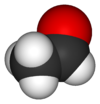
Space filling structures of some of these aldehydes look like this:


Ethanal  CH3CHO


Ketones on the other hand have alkyl groups on both sides of the carbonyl group


These are three of the simplest ketone structures.

Here is a typical space–filling picture of the simple ketone: propanone


Solubility in water:

The simpler aldehydes and ketones are completely miscible with water.

The solubility in water decreases as the carbon chain length increases.

Van der Waals forces (temporary dipole forces) between carbon chains begin to dominate over the hydrogen bonds formed between the aldehyde and water. 


The hydrogen bond is shown as a dotted line.

Note that the hydrogen bond is linear with a bond angle of 180o


Distinguishing an aldehyde from a ketone

There are a couple of chemical tests you can carry out to see if an aqueous solution contains a simple aldehyde or a simple ketone.

Both aldehydes and ketones will form a yellow crystalline precipitate with Bayer’s Reagent. 


But only aldehydes will form a red precipitate on heating gently with either blue Fehling’s solution or alkaline Benedict’s solution.

Aldehydes can be oxidised to carboxylic acids in this redox reaction.

CH3CHO   +   H2O          CH3COOH   +   2H+     +     2e–

The blue copper(II) solution is reduced to a red precipitate  of copper(I) oxide

2Cu 2+       +     2e–           2Cu+

Typical reaction of an aldehyde or ketone

Aldehydes and ketones undergo nucleophilic addition reactions with appropriate nucleophiles such as HCN.

The reaction with the weak acid HCN occurs in the presence of the soluble salt KCN.

The KCN is necessary since it provides sufficient CN– ions cyanide/nitrile ions.

KCN is fully ionised in aqueous solution whereas HCN is partially ionised since HCN is a weak acid:

HCN      +     H2O           H3O+   +    CN

The mechanism of nucleophilic addition looks like this:

Step one:


Step Two:

The negatively charged oxygen abstracts a proton from the HCN molecule
 

Step Three:

The catalyst :CN– is regenerated
 

If the ketone is asymmetrical as in the example below the product of the reaction with HCN is optically active but both optically active isomers form giving rise to a racemic mixture:


Problem:

What happens if an aldehyde, say CH3CH2CHO, is used instead of the ketone?

Can you work out the structures of the reaction products and see if they are optically active or not.


Is in fact a racemic mixture produced?

Friday, 1 April 2016

Carbonyl Compounds (1) Structure of the Carbonyl Group.


I’m going to begin a series of posts on the chemistry of the organic functional group the Carbonyl group. 

Let’s ask first what is a carbonyl group?

We can simply say it is a C=O group but that would be too simplistic really.

There are some very interesting and fairly good atomic orbital representations of the carbonyl group on line and we’ll look at a few soon enough.

First let’s reference the carbon –carbon double bond in ethene.

You’ll find my page on the ethene double bond here.

That page shows you how the molecular orbital theory attempts fairly successfully to account for the formation of the ethene double bond.

The two excited state carbon atoms form a sigma (σ) and a pi (π) bond.

The sigma bond is formed along the axis joining the two carbon nuclei and the pi bond forms in two halves above and below the plane of the molecule. 

The effect of the pi bond is to restrict rotation about the sigma bond.

The effect of this restricted rotation is that it is possible for the formation of geometric isomers of some types of alkene. 

Now in a similar way the carbonyl bond forms from an excited carbon and oxygen atom.

In their ground state, oxygen and carbon have the following electron configurations:


In the formation of the carbonyl double bond, certain changes must take place on the excitation of the atomic orbitals of both atoms for the atoms to form the corresponding molecular orbitals that then fit the chemistry of carbonyl compounds such as aldehydes. 

To fit the carbonyl reality, the molecular orbital model must produce an oxygen atom with two lone pairs of electrons since this feature is known to account for the solubility in water of some carbonyl compounds like aldehydes through hydrogen bonding with water. 

Furthermore, the molecular orbital model must account for the polarity of the carbonyl group since its polarity results in nucleophilic addition reactions between aldehydes and nucleophiles like HCN

And thirdly, the molecular orbital model has to account for the planarity of the carbonyl bond since this feature of aldehydes gives rise to racemic mixtures of products from some nucleophilic addition reactions.

The resultant model suggests that oxygen forms an excited state in which three sp2 orbitals form leaving a pz orbital. 

The model also suggests that the carbon atom forms three sp2 atomic orbitals by the excitation of an electron into the vacant 2pz orbital (see the large arrow in the diagram above.) 

The resultant excited atomic states for oxygen and carbon look like this:


The pz orbitals side–on overlap to form the π bond.

Two sp2 orbitals end–on overlap to form the σ bond.   

The situation has been variously pictured on different sites on the internet as follows:

First, this pictorial representation shows the situation before the formation of the molecular orbitals:


The second example shows the simplest carbonyl compound methanal or formaldehyde HCHO and shows how each bond forms quite nicely, again showing the situation before the formation of the molecular orbitals.

The next image comes from a youtube video cut, I think, and shows the formation of the carbonyl bond but you’ll note I hope a couple of mistakes in it.

First, the pz orbital is not shown at a different energy level to the sp2 atomic orbitals. 

Second, there’s a nice attempt to show the planarity of the structure but the problem is that the bond angles around the carbon atom have been shown to be all 120o when as we shall see shortly they are not all equal.  VSEPR rules apply.


The next image below helps in the way it attempts to show how the more electronegative oxygen atom draws the carbonyl bonding electrons towards itself.  Oxygen here is electron pulling.


The next two images are helpful but for the fact that they too show the bond angles around the carbonyl bond to be 120o when they are not because of the extra electron density of the carbonyl bond itself repelling the single bonds attached to the carbon atom. (see example below).


This image best shows the molecular orbital model of the carbonyl group.


Here is a final image showing the appropriate bond angles for a carbonyl compound such as an aldehyde. 

Note how the bond angles around the carbon atom have changed according to the electron densities of the particles and bonds attached. 


Finally then to summarise the structure of the carbonyl group:

1.    It is planar
2.    It is polar because of the electronegative oxygen atom
3.    It is composed of a σ and a π bond
4.    It is susceptible to nucleophilic attack on the delta positive carbon atom

5.    The bond angles around the carbon atom are not all 120o because of the extra electron density on the carbonyl group. 

Popular Posts