Showing posts with label Condensation Polymers. Show all posts

Saturday, 27 October 2018

Condensation Polymers (4) DNA (DeoxyriboNucleic Acid)

Relevant Specification Extracts:

AQA
3.3.13.4 DNA 
The structures of the phosphate ion, 2-deoxyribose (a pentose sugar) and the four bases adenine, cytosine, guanine and thymine 
A nucleotide is made up from a phosphate ion bonded to 2-deoxyribose which is in turn bonded to one of the four bases adenine, cytosine, guanine and thymine. 
A single strand of DNA (deoxyribonucleic acid) is a polymer of nucleotides linked by covalent bonds between the phosphate group of one nucleotide and the 2-deoxyribose of another nucleotide. This results in a sugar-phosphate- sugar-phosphate polymer chain with bases attached to the sugars in the chain. 
DNA exists as two complementary strands arranged in the form of a double helix. 
Students should be able to explain how hydrogen bonding between base pairs leads to the two complementary strands of DNA. 

DNA (DeoxyriboNucleic Acid)
In this fourth post on condensation polymers, I’m looking at the structure and properties of DNA and the formation of the polymer chain from the phosphate sugar and nucleotide.  I’m alos going to describe the nature of the intermolecular forces that exist between these polymer molecules so as to form the well known double helix. 

DNA 
As the name suggests DeoxyriboNucleic Acid contains a sugar - that’s deoxyribose, a base (there are four different bases in DNA) and the phosphate ion.  
This is the structure of de–oxyribose:


Notice that it is the oxygen on carbon atom number 2 that is missing from deoxyribose.
These are the structures of the four different bases in DNA:


And this is the structure of the phosphate anion PO43—


These three elements then form the basic DNA monomer—a nucleotide:


Nucleotides polymerise at the phosphate—sugar group to form the DNA polymer:


We finish with alternate sugar—phosphate—sugar—phosphate linked by covalent bonds:


This is then one strand of DNA.  The single strand can then conform in a double helix with another single strand of DNA to give the double stranded helix.  The link between the two strands occurs between bases (base pairs) via hydrogen bonds.
This is double stranded DNA:


The base pairs are:

The two strands of DNA are called complementary strands.
The two strands run anti–parallel to each other. 

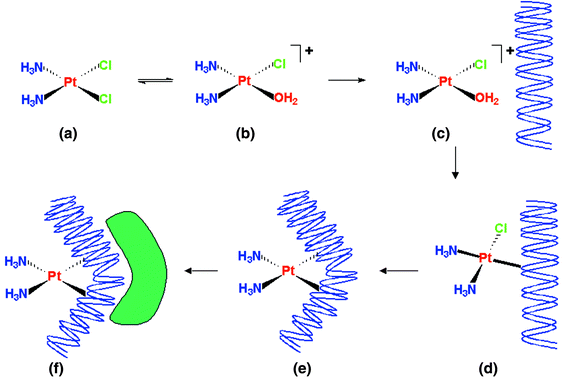
Some anti–cancer drugs (e.g cis–platin) it is thought act in such a way as to interupt the formation of the double helix or to stop the two complementary strands from separating in the replication process that is part of protein formation.
To quote the AQA  specification:


“Cisplatin prevents DNA replication in cancer cells by a ligand replacement reaction with DNA in which a bond is formed between platinum and a nitrogen atom on guanine.”
This effect is illustrated in the diagram below: 


Here the platinum atom complexes with the guanine at two points on the DNA and bends the chain so that the resultant conformation does not as easily facilitate replication.  
But as can be seen below the platinum can complex with guanine in other places so as to disrupt the DNA chain. 


Saturday, 6 October 2018

Condensation Polymers (3) Amino acids and Proteins

Relevant Specification Extracts:

OCR
6.2.2 Amino acids
Learning outcomes 
Learners should be able to demonstrate and apply their knowledge and understanding of: 
Reactions of amino acids 
The general formula for an α-amino acid as RCH(NH2)COOH and the following reactions of amino acids: 
(i)  reaction of the carboxylic acid group with alkalis and in the formation of esters
(ii)  reaction of the amine group with acids 
Edexcel 18B
16. understand the properties of 2-amino acids, including: 
i  acidity and basicity in solution, as a result of the formation of zwitterions
ii  effect of aqueous solutions on plane-polarised monochromatic light
17. understand that the peptide bond in proteins: 
i  is formed when amino acids combine, by condensation polymerisation
ii  can be hydrolysed to form the constituent amino acids, which can be separated by chromatography
AQA
3.3.13 Amino acids and proteins 
Amino acids and proteins are the molecules of life.  In this section, the structure and bonding in these molecules and the way they interact is studied.  Drug action is also considered. 
3.3.13.1 Amino acids (A-level only) 
Amino acids have both acidic and basic properties, including the formation of zwitterions. 
Students should be able to draw the structures of amino acids as zwitterions and the ions formed from amino acids: 
in acid solution and in alkaline solution. 
3.3.13.2 Proteins (A-level only) 
Proteins are sequences of amino acids joined by peptide links. 
The importance of hydrogen bonding and sulfur–sulfur bonds in proteins. 
The primary, secondary (α-helix and β–pleated sheets) and tertiary structure of proteins. 
Hydrolysis of the peptide link produces the constituent amino acids. 
Amino acids can be separated and identified by thin-layer chromatography. 
Amino acids can be located on a chromatogram using developing agents such as ninhydrin or ultraviolet light and identified by their Rf values. 
Students should be able to: 
- draw the structure of a peptide formed from up to three amino acids
- draw the structure of the amino acids formed by hydrolysis of a peptide
- identify primary, secondary and tertiary structures in diagrams
- explain how these structures are maintained by hydrogen bonding and S–S bonds
- calculate R
f values from a chromatogram.

Amino acids and Proteins
In this third post on condensation polymers, I’m looking at the properties of amino acids and the formation of proteins from amino acids, defining the repeat units of proteins and explaining the difference between primary, secondary, tertiary and quaternary structures of proteins, and the nature of the intermolecular forces that exist between these polymer molecules.
I’m going to discuss how amino acids combine with each other to form protein chains and how to spot the repeat unit and the peptide linkage between repeat units of protein.

Amino Acids
As their name suggests amino acids are part of both the amine family of molecules and the carboxylic acid family contain the –COOH and the –NH2 functional groups.
They have the general formula RCH2(NH2)COOH
You will also notice that amino acids are called α–aminoacids or 2–aminocarboxylic acids because the –NH2 group is on the second carbon atom of the chain.
Amino acids as optically active
You will also see that there is the potential for amino acid molecules to contain four different functional groups on the second carbon atom.
Four different functional groups on the second carbon atom means that the amino acid is optically active. It has two enantiomers: they rotate the plan of plane polarised light in opposite directions.
You can see the effect here in these diagrams:


Amino acids as zwitterions
Amino acids then carry the properties of both the carboxylic acid group–they are weak acids and the amino group–they are weak bases.  In fact they exist in an ionic form called a zwitterion (from the German for twin: zwitter).  In this form the proton from the carboxylic acid group has migrated to the amino group.  You can see this in the equation below:


Reaction with alcohols to form esters

Amino acids react with alkalis to form salts and with acids to form salts


Polymerisation of amino acids
Amino acids are the monomers of protein.  Amino acids combine in a condensation reaction i.e. the addition of two amino acids followed by the elimnation of a molecule of water.
The resultant linkage between the two amino acid residues is called a peptide link.
The basic protein structure is called its Primary Structure and this is just a sequence of amino acid residues.  See below and note the peptide linkages:


Note that is writing out the primary structure we begin with the amino nitrogen on the left.
However, amino acid R groups can interact with one another under the appropriate circumstances and this results in two types of secondary structure called α–helix and β–pleated sheet.  These two secondary structures are illustrated below.


You should be able to recognise and identify these structures in diagrams.
The structures are held in place when hydrogen bonds form between amino acid side chains or disulphide bridges form between cysteine side chains.  These are illustrated below:


When the secondary structures interact the hydrophobic water–hating side chains tend to move to the centre of the protein molecule and the water–soluble hydrophilic side chains move to the surface of the protein.  This produces a third structure type of structure obviously called the protein tertiary structure.
The α–helix and β–pleated sheet are like the struts and plates that hold the tertiary structure in place.
You can see the tertiary structure of myoglobin below.


Hydrolysis of a protein and analysis of its hydrolysate
To analyse a protein and determine the composition of a protein’s primary structure, the first step is to hydrolyse the molecule.
Hydrolysis is usually accomplished refluxing the protein for several hours in 3M HCl i.e. acid hydrolysis.  The resultant hydrolysate is then neutralised.
Hydrolysis occurs at the peptide linkage.see below


Paper or thin layer chromatography can be used to determine which amino acids are present in the hydrolysate. See the diagram below:


Comparing known amino acid Rf values with those of the components of the hydrolysate will provide the evidence needed to identify the amino acids in the protein’s primary structure. See the illustration below:
 How to determine an Rf value. 


Below are results of using ninhydrin to spot the movement of the amino acids on the chromatogram


Summary of Protein Structure


Thursday, 20 September 2018

Condensation Polymers (2) Polyamides


Relevant Specification Extracts:

OCR
6.2.3 Polyesters and Polyamides

Condensation polymers
(a) condensation polymerisation to form: 
  1. polyesters (ii) polyamides 
Formation from carboxylic acids/dicarboxylic acids (or respective di acyl chlorides) and from alcohols/diols or amines/diamines.
Learners will not be expected to recall the structures of synthetic polyesters and polyamides or their monomers. 
Edexcel 18B
14. know that the formation of a polyamide is a condensation polymerisation reaction 
15. be able to draw the structural formulae of the repeat units of condensation polymers formed by reactions between: 
i  dicarboxylic acids and diols 
ii  dicarboxylic acids and diamines 
iii amino acids 
AQA
3.3.12.1 Condensation polymers (A-level only) 
Condensation polymers are formed by reactions between: 
dicarboxylic acids and diols
dicarboxylic acids and diamines
amino acids.
The repeating units in polyesters (eg Terylene) and polyamides (eg nylon 6,6 and Kevlar) and the linkages between these repeating units.
Typical uses of these polymers.
Students should be able to:
draw the repeating unit from monomer structure(s)
draw the repeating unit from a section of the polymer chain
draw the structure(s) of the monomer(s) from a section of the polymer
explain the nature of the intermolecular forces between molecules of condensation polymers.
Polyamides
In this second post on condensation polymers, I’m looking at the formation of polyamides, defining the repeat units of polyamidess (e.g Kevlar or Nylon 6:6), and the nature of the intermolecular forces that exist between these polymer molecules.
I’m going to discuss how dicarboxylic acids (or acyl chlorides ) combine with diamines and how to spot the repeat unit and the linkage between repeat units of polyamide.

Formation of polyamides
As their name suggests polyamides are part of the amide family of molecules and contain the –CONH– functional group.
Like aliphatic and aromatic amides, polyamides are formed from either a carboxylic acid and an amine or a carbonyl chloride and an amine.
However, there is a distinguishing feature of these carboxylic acids and carbonyl chlorides: they are di–carboxylic acids and di–chlorides i.e. they have two acid groups or two acid chloride groups.  Similarly the amines used are diamines.
A typical dicarboxylic acid is hexan–1,4–dioic acid and a typical amine might be 1,6–diaminohexane. See below for their structures: 
hexan–1,4–dioic acid

1,6–diaminohexane


When these molecules combine a small molecules is eliminated in the case above that molecule is water H2O.
You can see that described in the reaction scheme below:  


You can see how the structures allow for a chain of units of acid and alcohol linked by amide groups to develop.
You should be able to draw the repeat unit of a typical polyamide such as Kevlar or Nylon 6:6.  These are shown below: 
Nylon 6:6

Kevlar


You should also be able to highlight the amide functional group in the polyamide structure as below.


If the acid used is hexan–1,4–dioic acid and the diamine is 1,6–diaminohexane then the resultant polymer was originally called Nylon 6:6.


And here is a picture of the actual material Nylon6:6 before it is spun and. stitched into a textile:


Such polyamide molecular chains stick together through the use of polar bonds (between CO groups and NH groups) and temporary dipole forces (between aromatic groups).  

Popular Posts