Showing posts with label Chemical Equilibrium. Show all posts

Sunday, 30 October 2016

Equilibrium (2) The significance of the value of Kc and Kp

 Edexcel A level Chemistry (2017)
Topic 11: Equilibrium II:
Here is the third learning objective:
11/II/5. To be able to understand that the value of the equilibrium constant is not affected by changes in concentration or pressure or by the addition of a catalyst

Within this topic, students can consider how chemists can use the concept of equilibria to predict quantitatively the direction and extent of chemical change.
The equilibrium constant is related to both temperature and the enthalpy change of a chemical reaction:


There is linear relationship between K and 1/T provided ΔHremains constant.  This is in fact the case to all intents and purposes, since ΔH changes very slowly with temperature.

But concentration and pressure changes have no effect on K for one reason is that changes in pressure on a gaseous equilibrium are only effective if there is a difference in the number of moles of reactants and product as here:

N2(g)    +     3H2(g)         2NH3(g)

But if the reaction is this:

                             H2(g)   +    I2(g)       2HI(g)

Then changes in pressure on this system have no effect on the position of equilibrium or therefore on Kp.

Kp remains constant if the pressure (or the concentration) changes. 

Addition of a catalyst is a different matter.

Catalysts lower the activation energy of a reaction and bring more molecules into a state where they might collide with others and break and make new bonds and form new products.

Catalysts are very inclusive.

But how do they work in equilibria?

Here is the typical energy profile of catalysed reaction:


The catalyst lowers the activation energy of the forward AND the backward reaction.

Therefore it cannot affect the position of equilibrium.

All it can do is reduce the time it takes for the reaction to reach equilibrium since the catalyst speeds up both forward and backward reactions.

Therefore a catalyst or pressure or concentration have no effect on the value of the equilibrium constant.

What the equilibrium constant does tell us is how far a reaction has gone.

From the value of an equilibrium constant we can tell if a reaction has gone to completion or not.
If
N2O4(g)       2NO2(g)  ΔH= +57.2kJmol–1


At 600K, Kp = 13800 atm

This means that the reaction has virtually gone to completion.

The partial pressure of N2O4 must be very low and that of NO2 very high for this value of Kp.

Similarly at 100K, Kp  =  3.61×  10–21 atm which is incredibly small and means that in the equilibrium mixture there is mainly N2O4 and very little NO2, in fact the decomposition of N2O4 has hardly begun.


So K the equilibrium constant is a measure of the extent of chemical change and therefore will be related to ΔG, the free energy change, ΔStotal the total entropy change and Eo the redox potential because all these thermodynamic quantities are also measures of the extent of reaction. 

Saturday, 29 October 2016

Equilibrium (2) Effect of temperature change on Kp and Kc

Edexcel A level Chemistry (2017)
Topic 11: Equilibrium II:
Here is the third learning objective:
11/II/3. To know the effect of changing temperature on the equilibrium constant (Kc and Kp), for both exothermic and endothermic reactions

If    N2O4(g)       2NO2(g)  ΔH= +57.2kJmol–1


Then the position of equilibrium moves left if the system is cooled.

Also if the system is warmed the position of equilibrium moves to the right forming more NO2 and the colour of the gas mixture darkens.

The reaction left to right is endothermic so Le Chatelier’s principle would suggest that the reaction is moving in such away to evolve heat when the temperature is lowered and to absorb heat when the temperature is raised.

But what is the theoretical basis for this conclusion?

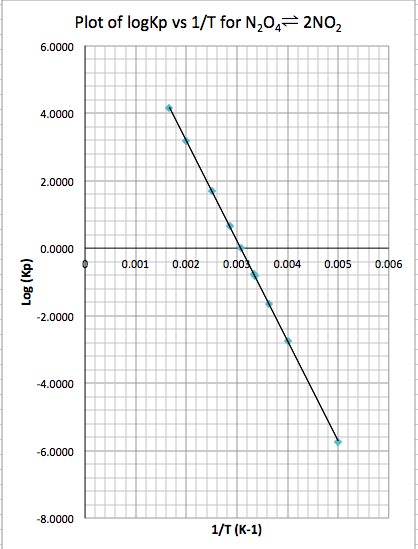
Experimental values show there is an approximate relationship between temperature and Kp.

The data in the table below reflects this relationship.


A plot of log10Kp vs 1/T  gives a straight line as the graph shows.


If it is assumed (and this is where the relationship becomes approximate) that ΔH is constant over the range of temperatures used then the graph shows that:


The slope of the graph is – ΔH/2.303 R.

This equation confirms quantitatively Le Chatelier’s qualitative principle.

If ΔH   is positive the forward reaction is endothermic, then as temperature increases, 1/T decreases so Kp increases and so the position of equilibrium must be moving to the right to favour products.  As was said above when the temperature is raised the system absorbs heat and moves to favour products.

A summary is given in the table below:


ΔH of forward reaction
Temperature change applied
Effect on value of K
Change in equilibrium position
Endothermic

Increase
Increase
Favours products
Endothermic

Decrease
Decrease
Favours reactants
Exothermic

Increase
Decrease
Favours reactants
Exothermic

Decrease
Increase
Favours products

Friday, 28 October 2016

Equilibrium (2) Calculations involving Kc and Kp

Edexcel A level Chemistry (2017)
Topic 11: Equilibrium II:
Here is the second learning objective:
11/II/2. To be able to calculate a value, with units where appropriate, for the equilibrium constant (Kc and Kp) for homogeneous and heterogeneous reactions, from experimental data

If you have been following this blog recently with the posts on calculation of Kc and Kp then the following examples should help you develop your understanding of this topic.

Example 1:

5 moles ethanol, 6 moles ethanoic acid, 6 moles ethyl ethanoate and 4 moles of water were mixed together in a stoppered bottle at 15℃.

After equilibrium had been reached the bottle was found to contain only 4 moles of ethanoic acid.

Calculate Kc for this reaction

CH3CH2OH    +    CH3COOH         CH3COOCH2CH3    +   H2O


CH3CH2OH
CH3COOH
CH3COOCH2CH3
H2O
Initial number of moles
5
6
6
4
Change in number of moles
–2
–2
+2
+2
Equilibrium number of moles
3
4
8
6


after substitution of the equilibrium values   Kc  =  4

Now suppose that 1 mole of ethanol, 1 mole of ethanoic acid, 3 moles of ethyl ethanoate and 3 moles of water are mixed together in stoppered flask at 15℃.

How many moles of each reagent exist in the bottle at equilibrium given that Kc  =  4.

Consider:


CH3CH2OH
CH3COOH
CH3COOCH2CH3
H2O
Initial number of moles
1
1
3
3
Change in number of moles
+𝝰
+𝝰
𝝰
𝝰
Equilibrium number of moles
1+𝝰
1+𝝰
3–𝝰
3–𝝰
Actual mole values at equilibrium
1.33
1.33
2.67
2.67

where  𝝰 is the degree of dissociation of ethyl ethanoate and water.  Since both these compounds are in the larger concentration the effect will be to push the equilibrium position to the left.  The concentrations of water and ethyl ethanoate will decrease.  Therefore these two species concentrations fall by the degree of dissociation 𝝰 where as the two reactants concentrations increase by the degree of dissociation, according to Le Chatelier’s principle.  


  taking roots


giving a value of   𝝰 =  0.333


Example 2:

At 200℃, Kc for the reaction:

PCl5(g)       PCl3(g)      +     Cl2(g)     ΔH  =  +124kJ

is  8 ×  10–3  mol.dm–3

A sample of pure PCl5(g) was introduced into an evacuated vessel at 200℃.  When the equilibrium had been reached the concentration of PCl5(g) was 0.2 ×  10–1  mol.dm–3

What are the concentrations of PCl3(g) and Cl2(g) at equilibrium?

Equation:  PCl5(g)       PCl3(g)      +     Cl2(g)     ΔH  =  +124kJ

From this we see that [PCl3(g)]  =  [Cl2(g)] because for every mole of Cl2(g) formed a mole of PCl3(g) also forms.

Kc = 8 ×  10–3   =     

At equilibrium [PCl5]  = 0.2 ×  10–1  mol.dm–3 

  [PCl3(g)]  ×  [Cl2(g)]  =  [PCl5(g)]  × 8 ×  10–3   
                                    =    0.2 × 10–1 × 8 ×  10–3   

[PCl3(g)]  =  [Cl2(g)]  =  √0.2 ×  10–1 × 8 ×  10–3   

                                             = 1.265 mol.dm–3 

Example 3:  (More difficult)

This is taken from Chemistry in Context p331.

At 488K the equilibrium constant for the reaction:

COCl2 (g)        CO(g)    +    Cl2(g)

is    2 × 10⁻⁶  atm

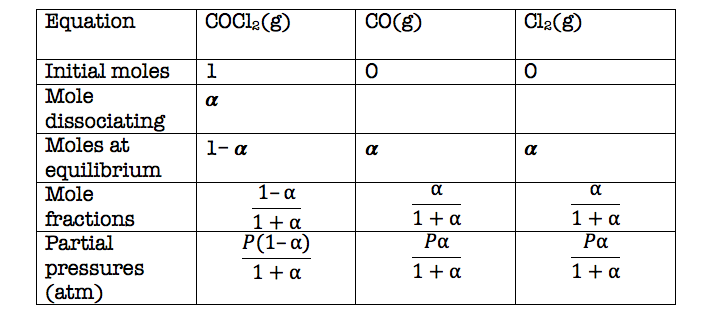
Assuming that the total pressure at equilibrium is P and the degree of dissociation of COCl2 (g) is 𝜶 , deduce a relationship between Kp,  𝜶 and P.

(Degree of dissociation (𝜶) is the fraction of COCl2(g) dissociated)

Let’s assume we have 1 mole of COCl2(g) initially in the reaction vessel.


After simplifying


The equation can be simplified further and a quadratic solution avoided since when 𝜶 is very small 1– 𝜶 or 1+ 𝜶 approximate to 1.

Therefore  Kp    P𝜶2

So at 1atm pressure P = 1atm

Then 𝜶  =   √Kp   =    2 × 10–6    =   1.414 × 10⁻³  

which as you can see is very small.

Example 4:

(From Selvaratnam and Frazer: Problem Solving in Chemistry)

Calculate the degree of dissociation when 0.500 mol of phosphorus pentachloride is maintained at 573K and 2.00 × 10⁵ Pa.  The equilibrium constant for this homogenous gas dissociation is 2.3 × 10⁻³ mol.dm–3 at 573K.

The previous problem provides a template with which to solve this example.


And finally if you have become proficient in calculating Kp, Kc   𝛂  the next question to ask is what does the value mean, what significance does it hold?

Popular Posts