Showing posts with label Acid–Base Equilibria. Show all posts

Wednesday, 9 November 2016

Acid-Base Equilibria (7) Control of Blood pH

Edexcel A level Chemistry (2017)
Topic 12: Acid–Base Equilibria:
Here are the final learning objectives in this topic:
12/23.  To be able to understand why there is a difference in enthalpy changes of neutralization values for strong and weak acids

12/24. To be able to understand the roles of carbonic acid molecules and hydrogen carbonate ions in controlling the pH of blood

Maintaining Blood pH levels:

Blood maintains a roughly constant pH of between 7.35 and 7.45.  It is a very narrow range of pH made possible because blood is buffered against the effect of excess acid or alkali.

If the pH falls below 7.35 a condition called acidosis occurs.  And if the pH rises above 7.45 a condition called alkalosis occurs. 

There are chemical reactions in the body whose products affect blood pH.  Respiration produces Carbon Dioxide.  Diffusing into the blood stream, carbon dioxide forms carbonic acid.  This increase in acidity has to be controlled.

Blood buffers based on CO2, hydrogen carbonate and water ensure that the pH of blood remains roughly 7.4.

Inside the red blood cells the pH is 7.25.   

Here the buffer is also aqueous CO2 or carbonic acid and hydrogen carbonate ions but haemoglobin molecules are acidic and lower the pH.

The buffer in blood depends on aqueous carbon dioxide CO2(aq) sometimes called carbonic acid H2CO3

Aqueous CO2 (written as H2CO3) acts as a weak acid.

Hydrogen carbonate ions HCO3act as its conjugate base.

If acid is added to the blood, the equilibrium shifts to the left as the hydrogen carbonate ions take up the excess H+

If alkali is added, the equilibrium shifts to the right as the OH— ions react with the H+ ions and more H2CO3 dissociates restoring the H+ level.


There are two organs that help control the levels of carbonic acid and hydrogen carbonate in the blood stream.  

The lungs remove excess carbon dioxide and the kidneys remove excess hydrogen carbonate ions.

Patients who have survived being badly burned or been exposed to heavy smoke or fumes are treated with an intravenous drip.  

This helps return the blood to a normal pH range. 

It increases flow into the kidneys and so removes hydrogen carbonate from the blood which in turn leads to the conversion of excess levels of CO2 into hydrogen carbonate.

In this way the blood is brought back to a healthy pH level.

If you are a runner you will know that if you run and then run faster your breathing rate increases and becomes deeper utilising more of your lung capacity.

What you are doing is vigorously expelling CO2 from the lungs and consequently from the blood stream to ensure your blood pH level remains within the normal range.

Problem:
In a sample of blood, the concentration of hydrogen carbonate ion is  3.0 × 10—2 mol.dm—3 and the concentration of carbon dioxide is 1.5 × 10—3 mol.dm—3 and Ka  = 4.5  × 10—7 mol.dm—3 .


What is the hydrogen ion concentration and the pH of this blood sample?

Monday, 7 November 2016

Acid-Base Equilibria (6) Buffer solutions and Buffer calculations

Edexcel A level Chemistry (2017)
Topic 12: Acid–Base Equilibria:
Here are the next learning objectives:
12/18. To know what is meant by the term ‘buffer solution’

12/19. To understand the action of a buffer solution

12/20. To be able to calculate the pH of a buffer solution given appropriate data

12/21. To be able to calculate the concentrations of solutions required to prepare a buffer solution of a given pH

Buffer Solutions and Buffer calculations
A buffer solution changes pH slightly or very little (the point to make is that the pH does NOT remain constant but changes little) when a strong acid solution or a strongly alkaline solution is added to it.

A buffer solution tends to resist change in pH.

However if sufficient strong acid solution or strongly alkaline solution is added the buffer breaks down completely.

A typical acid buffer solution is formed from equal amounts of a weak and its weak acid salt. 

So a solution that is 0.1M with respect to ethanoic acid and 0.1M with respect to sodium ethanoate is an acidic buffer solution. 


Buffer Action
Buffer solutions work like this:

Addition of a small volume of strong acid contains H+ ions.

These H+ ions have an effect on this equilibrium:

CH3COOH   +   H2O      CH3COO  +   H3O+


Rearranging gives

So if  [H3O+ ] is to remain constant the ratio of undissociated acid anion to undissociated acid has also to remain constant.

The addition of the sodium ethanoate to the ethanoic acid ensures there is an excess of ethanoate anions and these push the equilibrium to the left reducing the H+ ion concentration and giving the buffer solution a higher acid pH than the pH of ethanoic acid.

Any additional H+ ions added will react with the ethanoate anions and form more ethanoic acid pushing the equilibrium to the left, slightly reducing the pH.

Similarly if a small amount of strong alkali is added the OH ions with combine with the H+ ions to form water and the equilibrium will move slightly to the right increasing the pH slightly to compensate.


The arrows indicate the direction the position of equilibrium moves in the buffer with addition of H+ or OH—  ions.

As you must realise, the changes above do affect the ratio of undissociated acid anion to the undissociated acid and hence the pH.

Buffer calculations
Now if a buffer solution contains 0.1M ethanoic acid and 0.1M sodium ethanoate then we can calculate its buffer pH.

We must assume two things:

a)  that we can ignore the dissociation of water to form H3O+ ions

b)  that the weak acid ethanoic acid is so poorly dissociated that the dissociation does not affect the value of the concentration of the acid or that of the acid anion. 

Therefore use this form of the Ka equation:


Substituting the values for each species on the right hand side gives


[H3O+] =  1.8  ×  10—5

pH =   4.74


Now suppose we want to prepare a buffer solution of pH 5.7 from ethanoic acid and sodium ethanoate then again we use this equation:


we know that the pH of the buffer is 5.7 and therefore the [H3O+] is 10—5.7

so    [H3O+]   =  1.995  ×  10—6 mol.dm—3

if                                        Ka = 1.8  ×  10—5   mol.dm—3

then

then

therefore the ratio of [CH3COOH]  :  [CH3COO] is 1:11

If the volume of the buffer to be made up is exactly 1 dm3
then the litre should contain 11moles sodium ethanoate for every 1 mole of ethanoic acid from which the exact mass or liquid quantities can be determined. 

You should now be able to calculate the pH of buffers given their composition and the composition of a buffer given the pH required. 

Examples:

What is the pH of a buffer solution containing 0.05M ethanoic acid and 0.2M sodium ethanoate?

Given the pH required is 6.1 how can ethanoic acid and sodium ethanoate be sued to prepare this buffer?

Acid-Base Equliibria (5) Explaining titration curves (2)

Edexcel A level Chemistry (2017)
Topic 12: Acid–Base Equilibria:
Here are the next two learning objectives:
Explaining Titration Curves

12/16. To be able to draw and interpret titration curves using all combinations of strong and weak monobasic acids and bases

12/17. To be able to select a suitable indicator, using a titration curve and appropriate data

There are four basic types of titration curve, in this post I’m just going to look at the two less interesting:

a) Strong monobasic acid with weak monobasic base

This is the titration curve for a strong monobasic acid (HCl(aq)) titrated with a weak monobasic base (NH3(aq)).

We notice that:

• the titration curve starts at the pH of the strong acid 0.1M HCl i.e. pH =–log10[H+]  =  -log10 0.1 = 1.

• only methyl orange could be an acid-base indicator since the colour change occurs when pH change is rapid (vertical part of the “curve”).

• pH changes over 4 units at the end point 25.00ml.

• so we see why only a drop or two at the end point will turn the indicator colour from acid to alkaline—pH change is rapid at the end point.


b) Weak monobasic acid (CH3COOH) with weak monobasic base (NH3) titration curve:

What we notice is this:

• the curve starts at the pH of 0.1M ethanoic acid that is pH=2.9

• the curve rises slowly and the pH change levels off because this is a buffer region.

• why is this a buffer region? 
Because [CH3COOH] =  [CH3COO] the concentration of undissociated weak acid equals the concentration of dissociated acid anion, a typical condition for a buffer solution. 

• at 12.5ml when the acid is half neutralised the pH = pKa so given the Ka of ethanoic acid we can say that this pH is – log10 (1.58 × 10⁻⁵) or 4.8.

• why does pH = pKa at 12.50 ml?

at this point as we see [CH3COOH] =  [CH3COO] so in the Ka equation both terms will cancel:


Therefore  Ka   =   [H+]

So pKa  =   pH

• addition of further base destroys the buffer and the acid is neutralised at 25.00ml the end point of the titration. 

• the pH then does not rise rapidly but another this time alkaline buffer region occurs 

• There is therefore no indicator able to detect the end point of this titration so it is not possible to titrate a weak acid with a weak base.

Saturday, 5 November 2016

Acid-Base Equilibria (4) Explaining titration curves (1)

Edexcel A level Chemistry (2017)
Topic 12: Acid–Base Equilibria:
Here are the next two learning objectives:
Explaining Titration Curves

12/16. To be able to draw and interpret titration curves using all combinations of strong and weak monobasic acids and bases

12/17. To be able to select a suitable indicator, using a titration curve and appropriate data

There are four basic types of titration curve in this post I’m just going to look at the two most interesting:

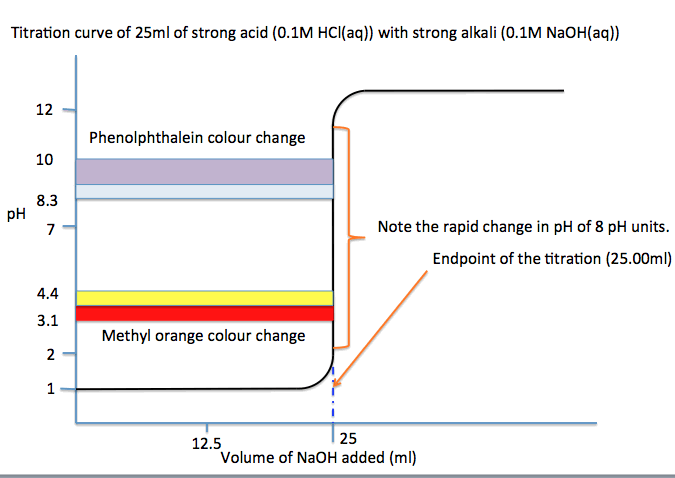
a) Strong monobasic acid with strong monobasic base

This is the titration curve for a strong monobasic acid titrated with a strong monobasic base.
We notice that:


• the titration curve starts at the pH of the strong acid HCl.

• both methyl orange and phenolphthalein could be acid base indicators since both colours changes occur when pH change is rapid (vertical part of the “curve”).

• pH changes over 8 units at the end point 25.00ml.

• so we see why only a drop or two at the end point will turn the indicator colour from acid to alkaline—pH change is rapid at the end point.


b) Weak monobasic acid with strong monobasic base titration curve:


What we notice is this:

• the curve starts at the pH of 0.1M ethanoic acid that is pH=2.9

• the curve rises slowly and the pH change levels off because this is a buffer region.

• why is this a buffer region? 
Because [CH3COOH] =  [CH3COO] the concentration of undissociated weak acid equals the concentration of dissociated acid anion, a typical condition for a buffer solution. 

• at 12.5ml when the acid is half neutralised the pH = pKa so given the Ka of ethanoic acid we can say that this pH is – log10 (1.58 × 10⁻⁵) or 4.8.

• why does pH = pKa at 12.50 ml?

at this point as we see [CH3COOH] =  [CH3COO] so in the Ka equation both terms will cancel:


Therefore  Ka   =   [H+]

So pKa  =   pH

• addition of further base destroys the buffer and the acid is neutralised at 25.00ml the end point of the titration. 

• the pH then rises rapidly over about 4 pH units this time not 8. 

• phenolphthalein is one indicator (there are others) that changes colour over this more limited pH range (7—11) and so it can be used in a weak acid–strong base titration. 

Wednesday, 2 November 2016

Acid-Base Equilibria (3) Defining and using Ka and Kw

Edexcel A level Chemistry (2017)
Topic 12: Acid–Base Equilibria:
Here are the next five learning objectives:
Defining and using Ka and Kw
12/9. To be able to deduce the expression for the acid dissociation constant, Ka, for a weak acid and carry out relevant calculations
12/10. To be able to calculate the pH of a weak acid making relevant assumptions
12/11. To be able to define the ionic product of water, Kw
12/12. To be able to calculate the pH of a strong base from its concentration, using Kw
12/13. To be able to define the terms pKa’ and ‘pKw
12/14. To be able to analyse data from the following experiments:
i  measuring the pH of a variety of substances, e.g. equimolar solutions of strong and weak acids, strong and weak bases, and salts
ii  comparing the pH of a strong acid and a weak acid after dilution 10, 100 and 1000 times
12/15. To be able to calculate Ka for a weak acid from experimental data given the pH of a solution containing a known mass of acid

If pH is an unreliable measure of acid strength then chemists turn to Ka and use that value.

Ka is called the acid dissociation constant.

If a weak acid dissociates like this:

CH3COOH    +H2O       CH3COO—   +    H3O+

Then Kc can be written:

but it is pretty safe to assume that the concentration of water remains constant during the dissociation of the weak acid since it is hardly dissociated and the position of equilibrium is well over to the left. 

Therefore this relationship leads to a second constant which is called the acid dissociation constant Ka.


The acid dissociation constant gives us a direct measure of the extent of dissociation of the hydrogen ions and therefore of the strength of the weak acid. 

There are tables of Ka values on the internet.

Let's see how to use Ka to calculate the pH of a solution of a weak acid.

What is the pH of a 0.1M solution of chloroethanoic acid (CH2Cl.COOH)?

CH2Cl.COOH   +    H2O      CH2Cl.COO   +   H3O+


But we can also say that [CH2Cl.COO]  must equal [H3O+ ]
From the equilibrium equation.

So we can re write the Ka equation like this:


What’s more since this is the dissociation of a weak acid it is reasonable to assume that the concentration of the acid hardly changes on dissociation.

So [CH2Cl.COOH] the undissociated acid is the same concentration at equilibrium which is 0.1M.

Therefore:


rearranging gives:

[H3O+]    =     √1.4× 10⁻⁴

[H3O+]   =   1.18  × 10–2  mol.dm—3

and from this

pH   =    — log10[H3O+]

pH   =   1.93

Now the best way to get your head round this is to do as many calculations as you can.

Here are a few to get you started:

What is the pH of

0.1M ethanoic acid (CH3.COOH)
0.1M hydrogen cyanide (HCN)
0.1M chloroethanoic acid
0.45M benzoic acid (C6H5.COOH)

You can find the relevant Ka values here on the internet..

So what happens if we apply a similar argument to water itself?

Water ionizes itself like this

H2O    +     H2O          H3O+    +     OH

And for this equilibrium Kc be:


Now in either acidic or alkaline conditions the concentration of water remains virtually constant being so high compared with the concentrations of the other species (it is over 50M). 

So incorporating the water term in the constant gives us Kw the ionic product of water. 

Kw  =   [H3O+]×[OH]

And if we take negative logs to base 10 of this expression we are left with a very convenient term.

pKw   =    pH   +   pOH  =  14

for most aqueous solutions of weak acids and bases at 298K.

From this we can also see that at 298K

[H3O+]   =   10—7  mol.dm—3

and  therefore for water at 298K

pH   =   7


So let’s calculate the pH of a solution of a strong base: 0.1M sodium hydroxide solution.

This solution will have a hydroxyl ion concentration of 0.1M.

Now

pH  +   pOH   =14

 pOH  =   —log 10 [OH]

pOH   =   —log 10(0.1)  =  1

pH   =   14     1   =   13


Finally, in this long post let’s describe how to calculate Ka of a weak acid given its solution concentration in grams per litre.

Suppose that the pH of a solution of ethanoic acid is 3.4O and we have 250ml that contain 0.15g of the acid. 

The concentration of the acid is 0.6 g.dm—3

And that is 0.6/60 =  0.01 mol.dm—3

From the pH was can find the [H3O+] since [H3O+]  =    10—pH

[H3O+]   =   10—3.4    =  0.000398 mol.dm—3

from this we can construct the Ka value since we know [H3O+] and can assume that [CH3.COOH] =  0.01M  as it is a weak acid and is therefore hardly dissociated.

Therefore      


1.58   ×  10—5 mol.dm—3

Popular Posts