Showing posts with label Crude Oil. Show all posts

Tuesday, 17 February 2015

Crude Oil (5): Matching supply and demand for crude oil products

What is cracking and why is it important in the oil industry?

Here are some details of the problem of supply versus demand for crude oil fractions (the figures are percentages)

As you can probably see the excessive demand is for petrol//gasoline and there is an oversupply of fuel oil.

So smaller molecule hydrocarbons are in demand and larger molecule hydrocarbons are in excess.  

How can one molecule change into another because if that happened it might be possible to match supply with demand.

Breaking a large alkane molecule into smaller molecules is called cracking.

How is cracking achieved?

First here is a link to a school experiment you might have done on this. 

And here is a video about the industrial process of cracking:
 

Note these points about the laboratory process:
  • usually liquid paraffin is cracked
  • it needs a high temperature and a catalyst (usually aluminium oxide: Al2O3)
  • it converts large hydrocarbon molecules into smaller ones that are more useful
  • it makes more petrol
You can tell cracking converts large molecules into smaller ones because the molecules cracked are liquids but the smaller ones produced are gases at the same temperature.  

Here's another thing the product molecules are of two basic types of hydrocarbon: alkanes and alkenes.

Alkanes are generally CnH2n+2   alkenes are generally CnH2n

Examples:
butene C4H8
butane C4H10

Thing is alkanes are pretty unreactive and tend to be used as fuels or solvents.

Alkenes are much more reactive (its the double bond) and there's a much wider group of products they can be converted into including polymers (more about this in another blog) 


So here are three equations to show you what happens when different alkanes are cracked:


You ought to try and build your own equations. 

The key to getting this type of equation right is to remember that all the carbons and hydrogens on the left add up to the same number of carbons and hydrogens on the right hand side. 

Look at equation (b), there are 12 carbons on the left and 6+2+4=12 carbons on the right.  

You can check the hydrogens for yourself.

So here's a task for you: write three cracking equations (no pun intended!!) for the cracking of undecane C11H24.  

Name all the products you come up with.  Have fun!!!!

Pages on the "Mole" and "Using the Mole" in chemical calculations are here 


Crude Oil (4): Transportation and Exploitation: environmental and political

Making Crude Oil Useful: What are the potential environmental problems in using crude oil?

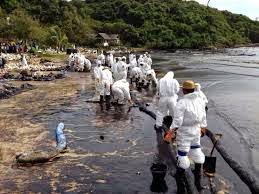
Transporting millions of gallons of an oily liquid that doesn't mix with water but floats on it, across the sea in steel containers with thin sides (called tankers) is at some point going to lead to problems.


Crude oil is gooey and sticks to birds feathers, other wildlife and rocks.

Then to clean up a spillage of crude oil means agencies using detergents which also damage wildlife.


here are some pictures of the kind of damage done:


And here is a recent video report from the BBC of an oil spill and fire in West Virginia USA.

Making Crude Oil Useful: What are the potential political problems in using crude oil?

What happens if the UK obtains its supply of crude oil or natural gas from a politically unstable country?

The issue of a politically stable supply is urgent today (February 2015)  since some people see some oil supplying countries as either ungovernable (Libya or Iraq) or unfriendly towards the UK (Iran or Russia) or with governments that may change quickly (Nigeria or Venezuela).

It would be better if Britain was self-sufficient in crude oil and natural gas which is why so much money has been spent exploiting the resources of oil and gas under the North Sea.

But Britain has to take supply from politically unstable countries because the country is not self sufficient in oil.

The risk Great Britain takes in being supplied with crude oil from a politically unstable country is

  • they might not pay up
  • their Government could fall and cut off the supply
  • their Government could raise the price of oil 

The third risk is greater if the country is not a member of the oil cartel OPEC: the Organisation of Petroleum Exporting Countries.


Pages on the "Mole" and "Using the Mole" in chemical calculations are here


Thursday, 12 February 2015

Crude Oil (3): Alkanes and the hydrocarbon code

Cracking the Hydrocarbon Code:

In this post I'm hoping to help you know how to build the formulas of the one type of hydrocarbon called an alkane: cracking the hydrocarbon code.

There are three parts to the hydrocarbon code:

Part 1:  The prefix of the hydrocarbon name:

The prefix of the hydrocarbon name tells you how many carbon atoms are in the molecule of the hydrocarbon so:


Part 2: The suffix of the hydrocarbon name:

The suffix of the hydrocarbon name tells you the type of hydrocarbon.

There are three basic types according to the type of bond between the carbon atoms.

-ane:              only single bonds between all atoms
-ene:              one double bond between two carbon atoms: the rest single bonds
-yne:              one triple bond between two carbon atoms: the rest single bonds


This table shows you the simplest examples of the alkanes and the alkenes.  

You ought to work out how the displayed formulas of the alkynes would look.  

To help you here are the first three names and formulas: ethyne C2H2, Propyne C3H4, and Butyne C4H6.  

For those who want to check how you did, you can find some answers scrolling down this page here

Lastly, here is a table of the first ten alkanes with there boiling points:


Here is task you can do: try plotting number of carbon atoms against boiling point and seeing what the chart looks like and then see if you can predict from your chart the boiling point of a hydrocarbon with eleven carbon atoms.

You'll find an answer here.

The explanation for your chart takes us back to the first post on oil fractionation.

Fractional distillation happens because all the different parts of crude oil have different boiling points.

The different fractions have different boiling points because they contain particles (hydrocarbon molecules) with different structures.

The structures contain just two key elements-carbon (C) and hydrogen (H) hence hydrocarbon.

The more carbon atoms the higher the boiling point.

Here are the trends we can observe in the fractions from crude oil:

low boiling point     <-------------------------------------> high boiling point
small hydrocarbons <-------------------------------------> large hydrocarbon
low density              <------------------------------------------> high density
runny and thin         <------------------------------------------> viscous and dense
weak intermolecular forces <-------------------------------------> high intermolecular forces
lighter colour          <------------------------------------------> darker colour
distill from higher                                                          distil from lower
on the column        <------------------------------------------>  down the column


Pages on the "Mole" and "Using the Mole" in chemical calculations are here 


Tuesday, 3 February 2015

Crude Oil (2): How did petroleum form?

So here is the question today: how did petroleum form?

Here are a few pictures of different types of liquid crude oil:
This is heavy crude or very dense and thick crude oil could be from Saudi or other Middle Eastern area


Here is a range of different fractions taken from the fractional distillation of crude oil

Here is a lighter crude, note how much runnier it looks: could possibly be from the North Sea fields.

The question is how do these different types of crude oil form in the first place? 

All crude oil consists of molecules of hydrocarbons i.e. compounds formed from hydrogen and carbon only.  

There are no molecules containing oxygen in the oil. 

Where could the carbon and hydrogen have come from for these molecules to exist in crude oil? 

Carbon is the molecule in all life forms on Earth so crude oil, we assume, started life in the from of living sea organisms: marine animals and plankton. 


But how did these living organisms turn into oil?

The argument goes that when these organisms died they rotted down in the absence of oxygen.  

Since oil is found in layers of sedimentary rock the argument goes these dead organisms were covered with layers of sediment that sealed them into layers of soft rock.  

Given a long time span, changes occurred that turned organisms into oil. 

Heat from below the earth and the pressure of the millions of tonnes of sediment above also played a part. 

If impervious rock forms above the soft sedimentary rock it traps the oil molecules and they remain there until drilling hits the sweet spot and the oil, under immense pressure, shoots out the ground in what's called a blow out!!


 Here is a video of the effects of a gas blow out in the Gulf of Mexico.

Pages on the "Mole" and "Using the Mole" in chemical calculations are here
Friday, 30 January 2015

Crude Oil (1): Oil fractionation

Welcome to savvy-chemist.com.

In this post we discuss a key chemical refinery process: Oil Fractionation or Fractional Distillation.

Oil fractionation is one of the likely starting points in the study of chemistry.

It is also discussed at several different levels and the reasons aren't hard to find.

Oil fractionation is a key starter process in chemical production that leads to a host of products often called petrochemicals and/or fuels e.g LPG, Petrol or Gasoline, Kerosene, Diesel are fuels whereas plastics, solvents and lubricants might be called petrochemicals.

Much of what we do in life today relies on these types of compounds and what chemists can derive from them like plastics.

These compounds begin life in a mixture of many different hydrocarbons: called petroleum or crude oil.

Several questions arise at this point:

#1. How can this mixture of hydrocarbons be separated?

#2. How did petroleum form in the first place?

#3. What is hydrocarbon?

In this post we are going to discuss how the petroleum mixture of hydrocarbons is separated.

Further posts will address the other two questions.

How to separate a mixture of hydrocarbons or how oil fractionation happens.

Oil fractionation or fractional distillation depends on the parts of the mixture being all liquids with different and distinct boiling points.

The fact is that the crude oil that is extracted from under the North Sea or from under the deserts of Saudi Arabia is mixture of molecules that have different boiling points.

So if this mixture is heated to a high temperature (say about 350°C) and pumped into long vertical tube (called a fractionating tower) then the smaller molecules with low boiling points rise to the cooler parts of the tube and the larger molecules with higher boiling points tend to remain in the lower parts of the tube.

You can find several diagrams of this on the net I've included a few for you to see how they are drawn.

If you are studying chemistry you will find that you will be questioned on how this process works so below I have reproduced a typical question from a very recent exam paper at GCSE that focuses on this area and also you can see something of the chemistry points that were expected in a typical high level answer.

You can find the full question and answer here.


So here are the bullet points looked for in the answer:

Examples of chemistry points made in the response could include:
  •   Some / most of the hydrocarbons (or petrol) evaporate / form vapours or gases

  •   When some of / a fraction of the hydrocarbons (or petrol) cool to their boiling point they condense

  •   Hydrocarbons (or petrol) that have (relatively) low boiling points and are collected near the top of the fractionating column or hydrocarbons with (relatively) high boiling points are collected near the bottom of the fractionating column

  •   The process is fractional distillation

  •   Heat the crude oil / mixture of hydrocarbons or crude oil / mixture is heated to about
    350°C

  •   Some of the hydrocarbons remain as liquids

  •   Liquids flow to the bottom of the fractionating column

  •   Vapours / gases rise up the fractionating column

  •   Vapours / gases cool as they rise up the fractionating column

  •   The condensed fraction (or petrol) separates from the vapours / gases and flows out through a pipe

  •   Some of the hydrocarbons remain as vapours / gases

  •   Some vapours / gases rise out of the top of the fractionating column

  •   There is a temperature gradient in the fractionating column or the fractionating column is cool at the top and hot at the bottom.

These points help to clarify what is happening inside the fractionating column.  

Let's just note some features of the expected answer: 
the column is called a fractionating column, 
there is a temperature gradient: hot at the bottom to cool at the top because it is cooler the further from the heat source, 
fractions are just parts of the crude oil mixture and these fractions tend to boil over a very narrow range of temperatures for example 250-300°C, 
larger molecules have the higher boiling points so these molecules form the fractions emerging from the lower parts of the column. 

More about fractional distillation in my next post. 

If you appreciated this post please add a comment or question and I will post an answer on the blog. 

Here is a source of an experiment about fractional distillation.

Here is a task where you can cut and put together a sketch of a fractionation column:
Pages on the "Mole" and "Using the Mole" in chemical calculations are here


Popular Posts